Turning real places into 3D tours you walk through in a browser.
Splatr started as my master's research at Leeds and runs as a working product today. It takes ordinary photos or video of a real place and turns them into a 3D tour you can capture, clean up and publish without ever leaving the browser. Below is the problem I set out to solve, the two people I designed for, and the product that came out of it.
- Role
- Founder & product designer
- Context
- MSc research, University of Leeds
- Type
- 0→1 platform · Working MVP
- Built for
- UK museums, galleries & heritage sites
Capturing a place in 3D was never the hard part. Everything after it was.
The technology to scan a site into 3D already worked. The trouble started the second the capture finished: the data landed on a local drive, openable only in heavy desktop software most heritage teams don't run. So preservation was happening. Seeing it wasn't.
The bottleneck
Quality 3D is slow, costly and technical to produce. Most heritage teams can't make it at all.
The access gap
What does get digitised gets locked in an archive. The public it was made for never sees it.
The experience gap
Even when a model exists, it feels like a file, not a place. People rotate it once and move on.
The first gap is an engineering problem. The other two are a design problem, and closing the distance between a captured place and a person is the part I owned.
Two very different users, on either side of the same distance.
On one side, the people who can't get to the place. On the other, the institutions trying to save it before it's lost. Splatr is the bridge, so I mapped both before designing anything.
Save the place, and open it to everyone who can't be there.
Anyone kept from heritage by more than the price of a ticket.
Too far to travel
Students and the curious an ocean away from the collection they're learning from.
Priced out
People who can't fund the flights and fees a site in another country asks for.
Health keeps them home
Visitors who can't make the trip, so the place has to come to them instead.
Less mobile
Elderly and disabled visitors for whom stairs and distance quietly close the door.
Museums and heritage bodies racing to protect what they hold.
Safeguard what's fragile
A 3D record outlasts war, fire, climate and the slow wear of over-tourism.
Widen access
Reach audiences far past the museum gate without moving a single artefact.
Teach and research
One capture reused across classrooms, scholarship and conservation.
Sustain the work
Virtual visits and experiences help fund the preservation that made them.
So I moved the entire journey off the desktop and into one browser tab.
Raw capture goes in, a live, shareable tour comes out, all in the same tab. That collapses a workflow that used to sprawl across local drives and desktop software into something a museum team can actually run. Three principles held it together.
Hide the hard part
Reconstruction is genuinely complex. None of that should reach the person using it, so the hard decisions happen underneath a single, plain choice.
Put people inside the place
The published tour behaves like a game: first person, walk where you like, with sound and light reacting as you move. Exploring should feel like being there.
One model, many jobs
The same capture tells a story to a visitor and gives a conservator exact, real-world measurements. One asset, two very different jobs, no rebuild.
The screens I designed.
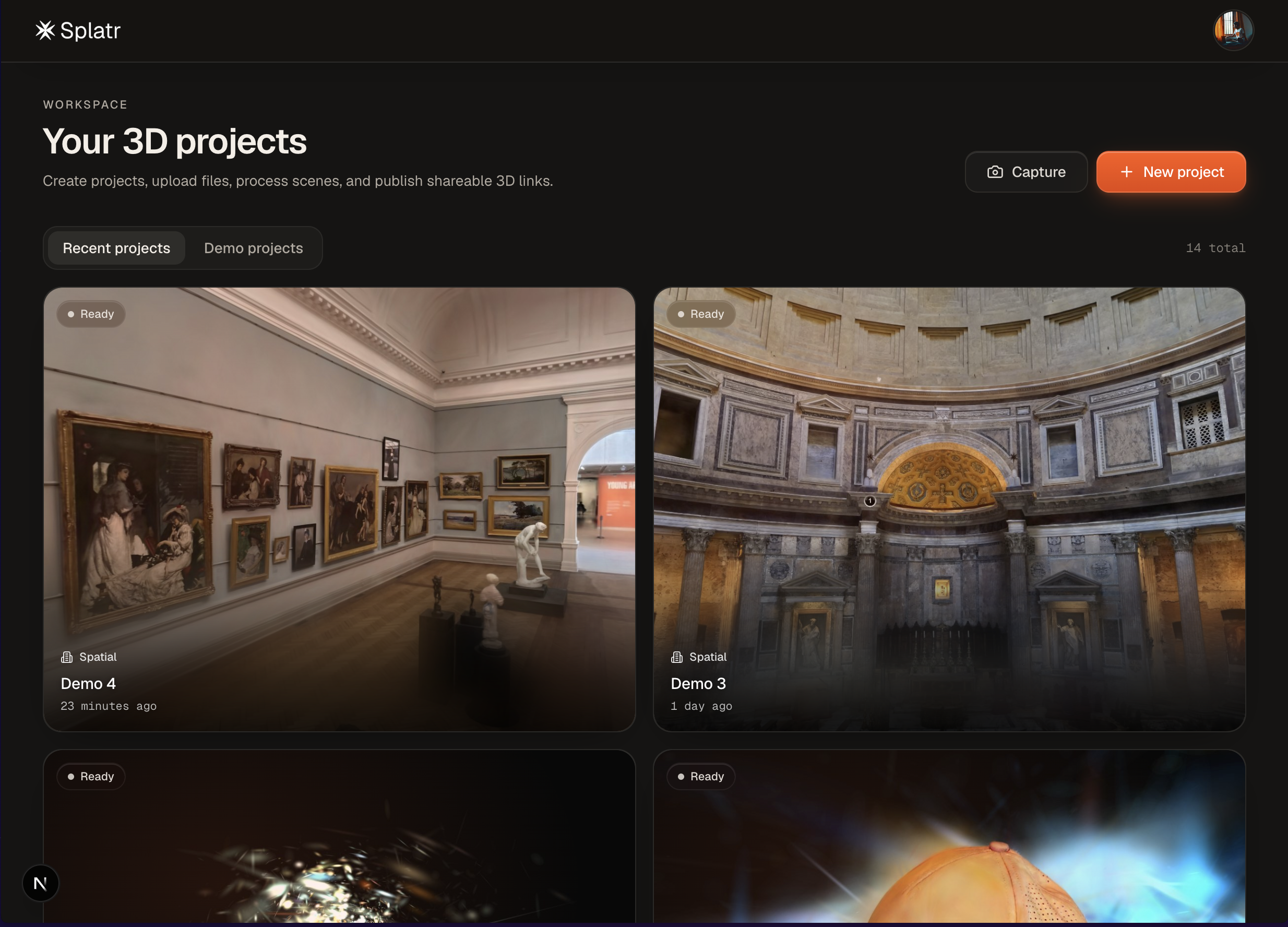
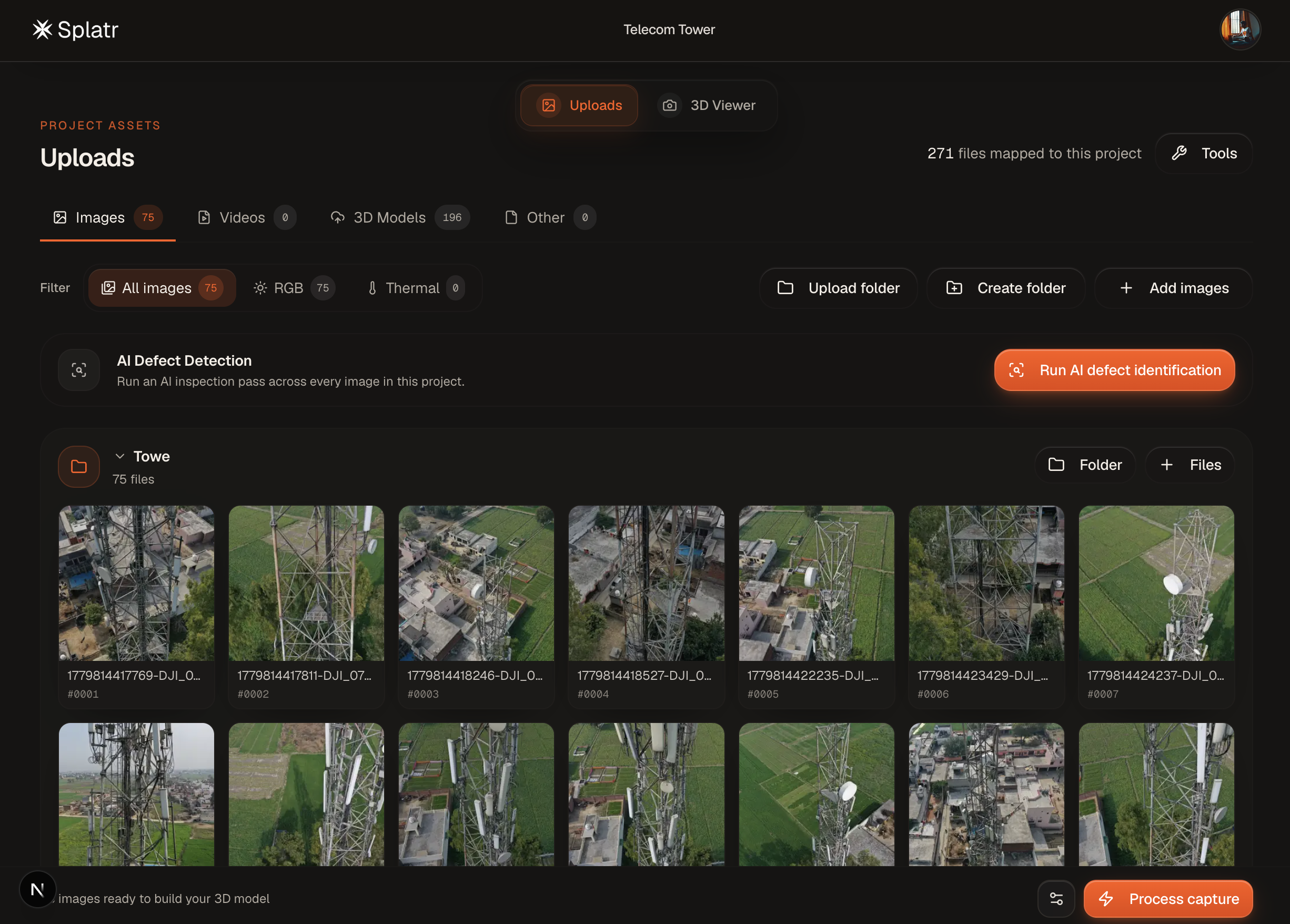
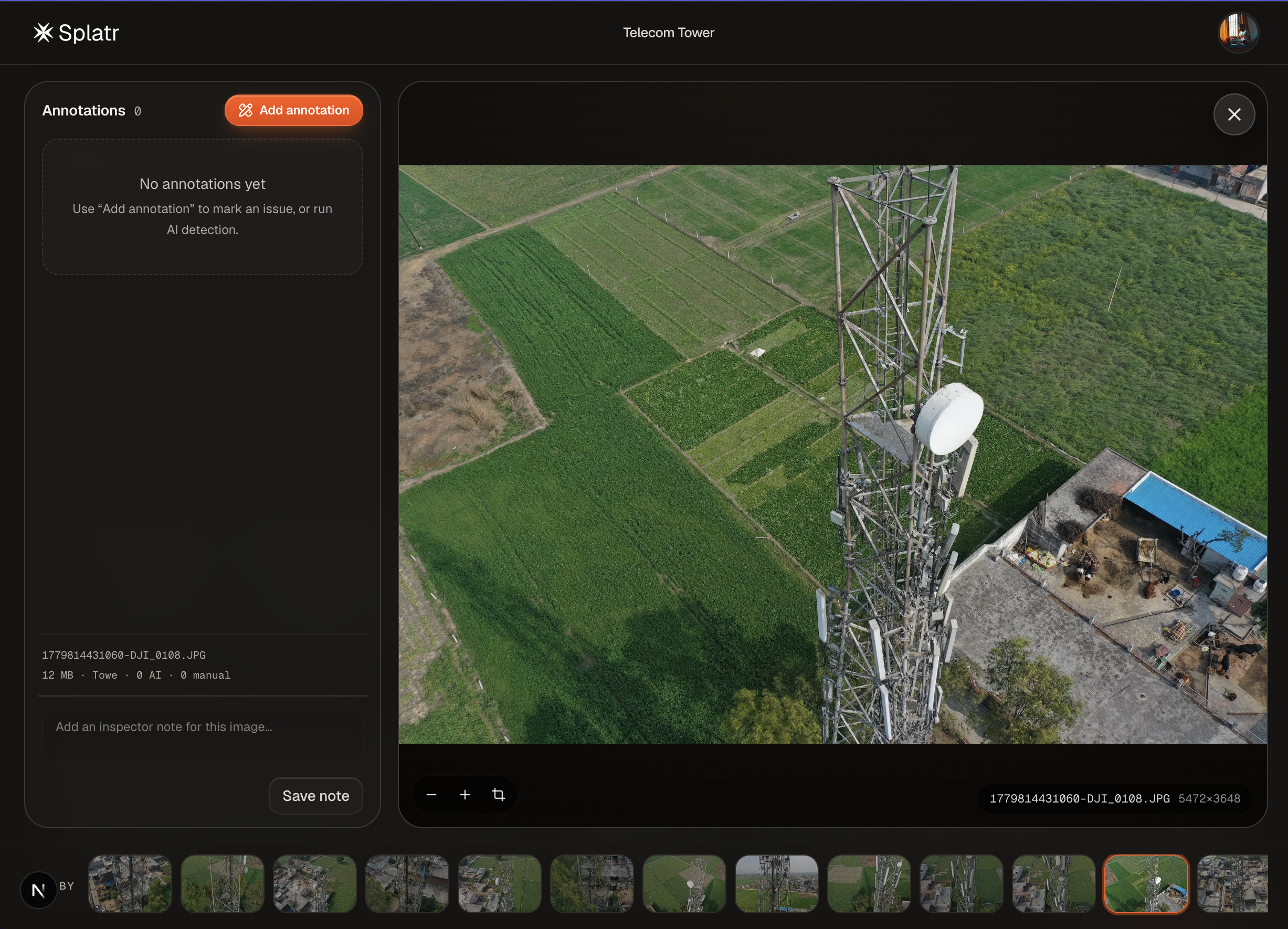
Two surfaces: the public site that explains Splatr, and the app where a place actually becomes a 3D tour.
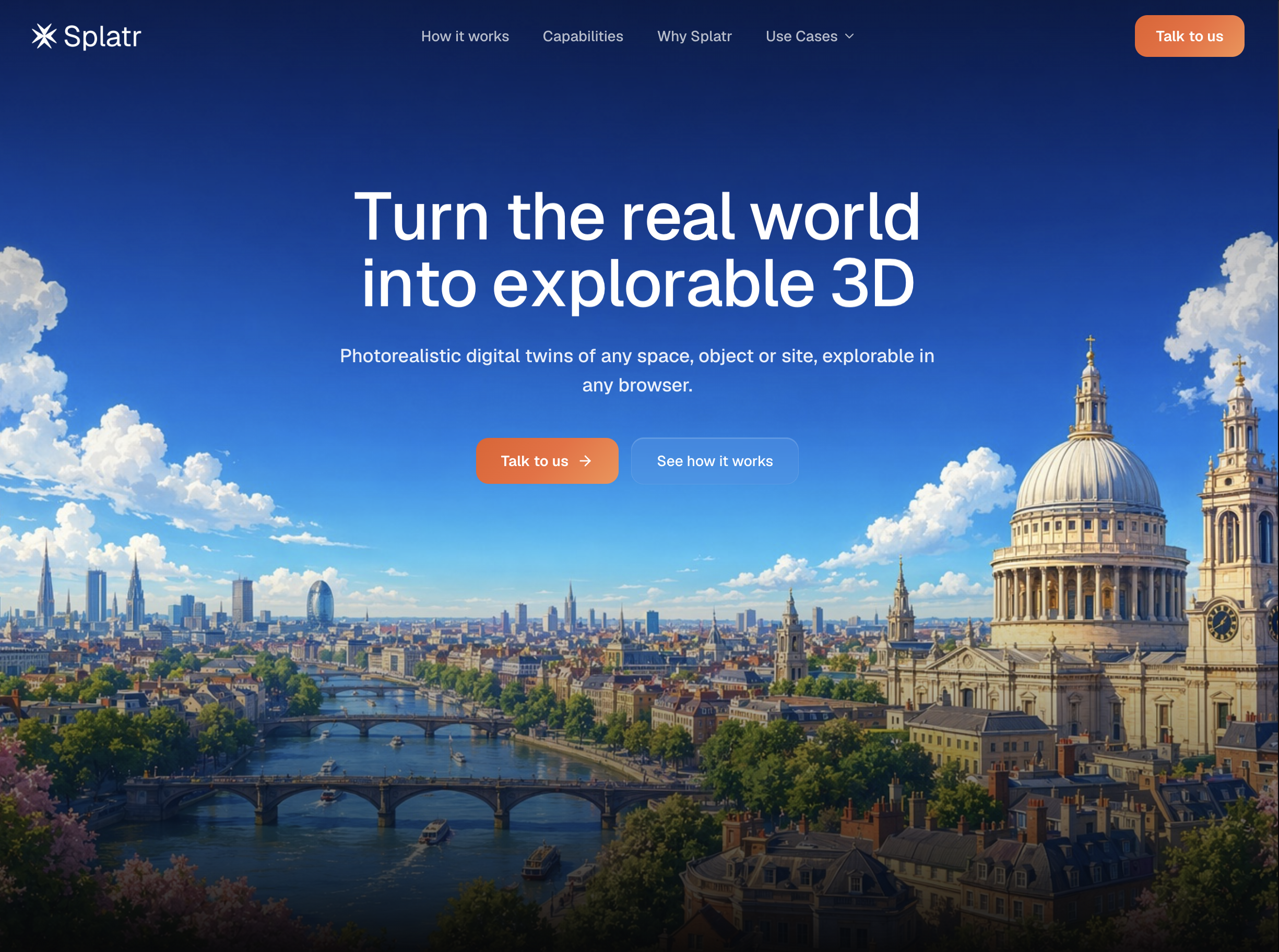
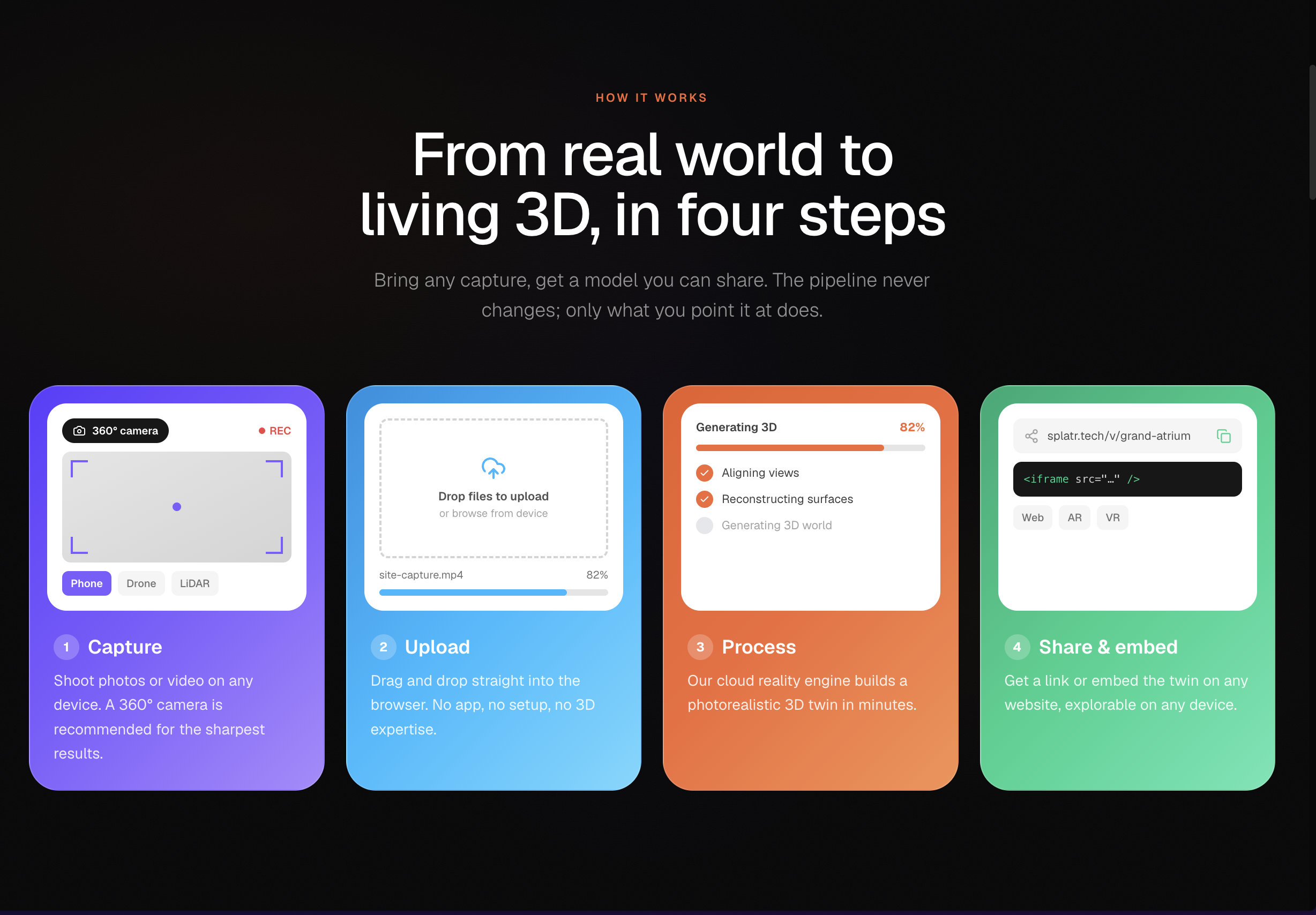
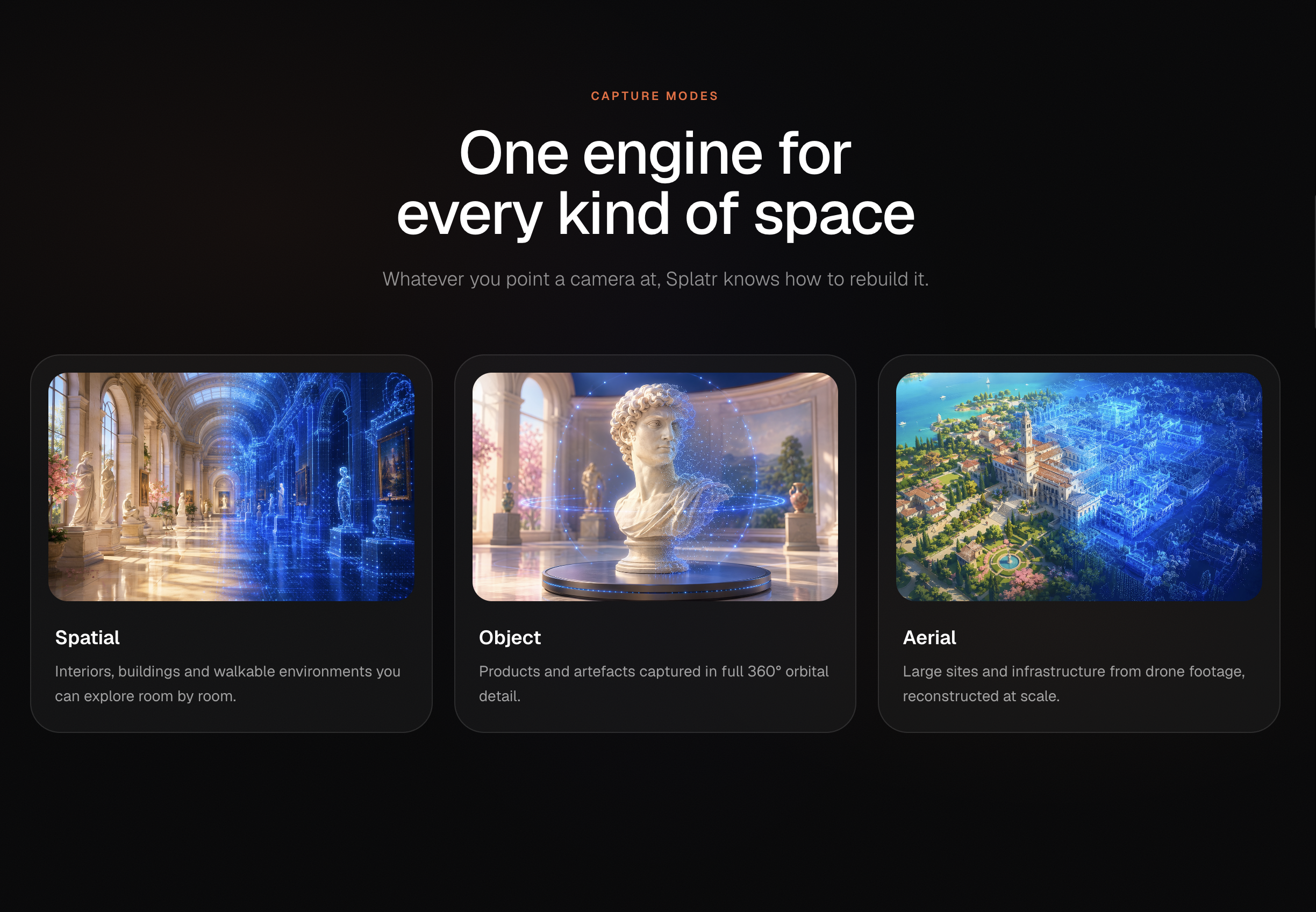
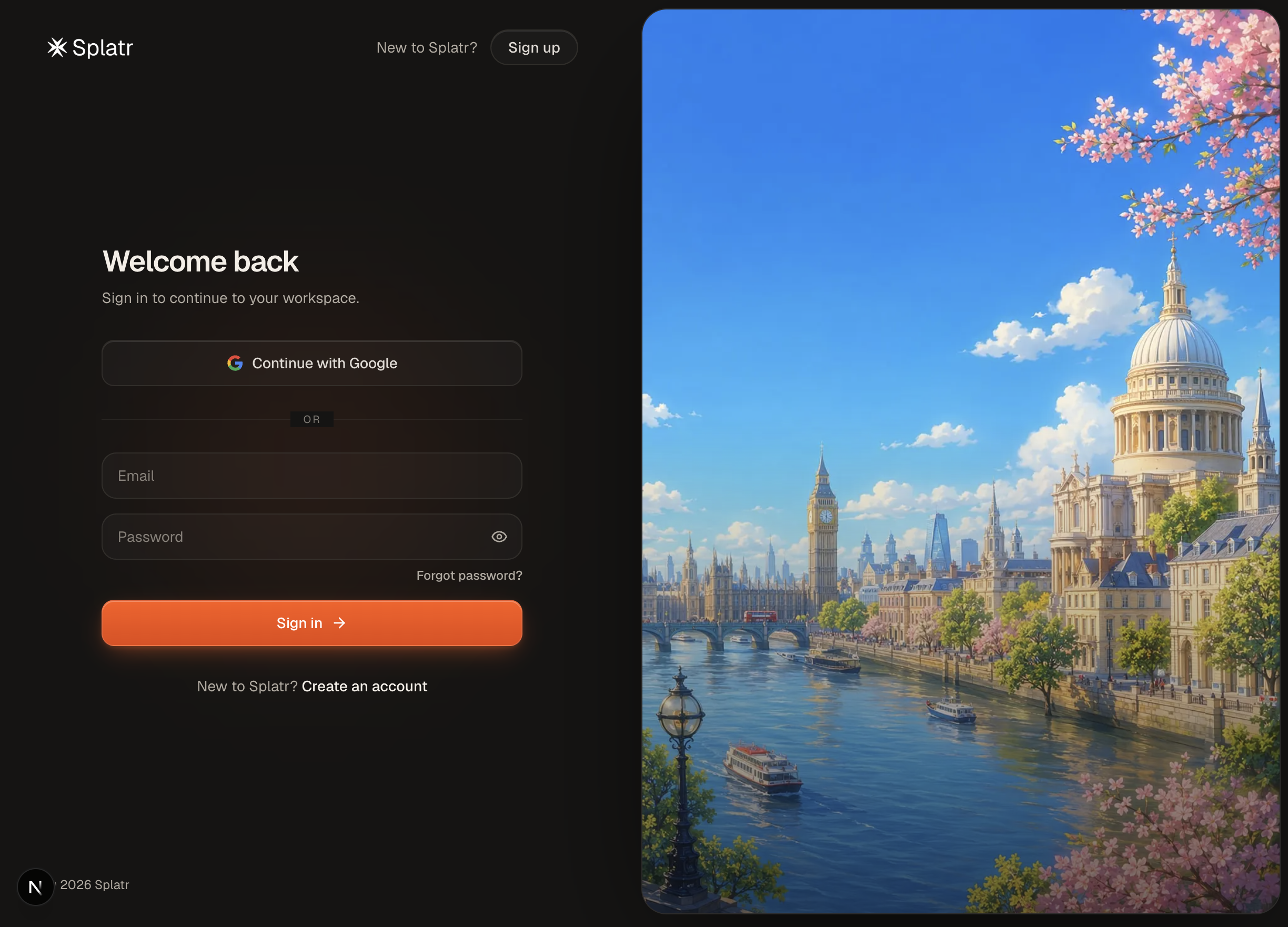
Capture, explore, measure, edit.
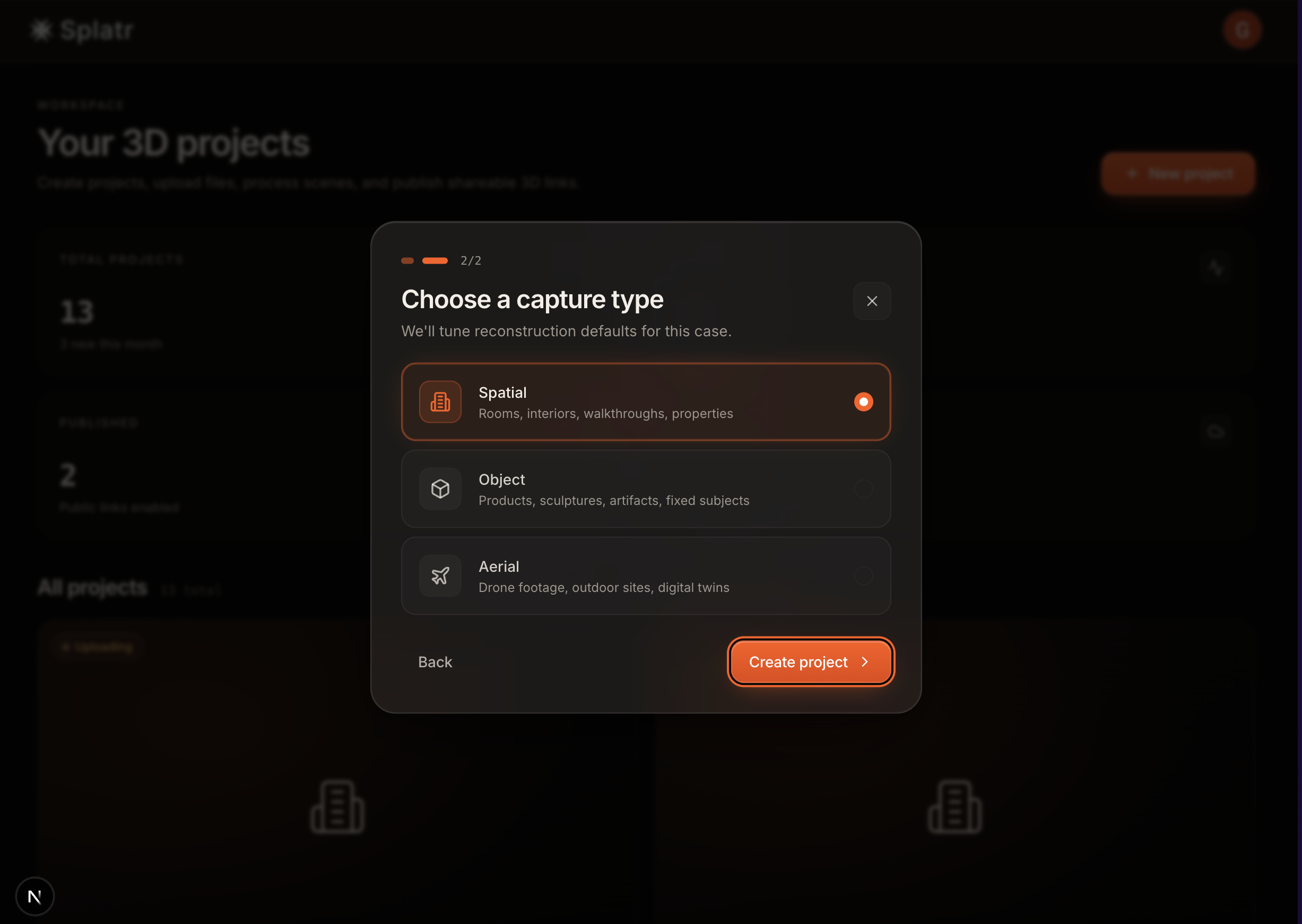
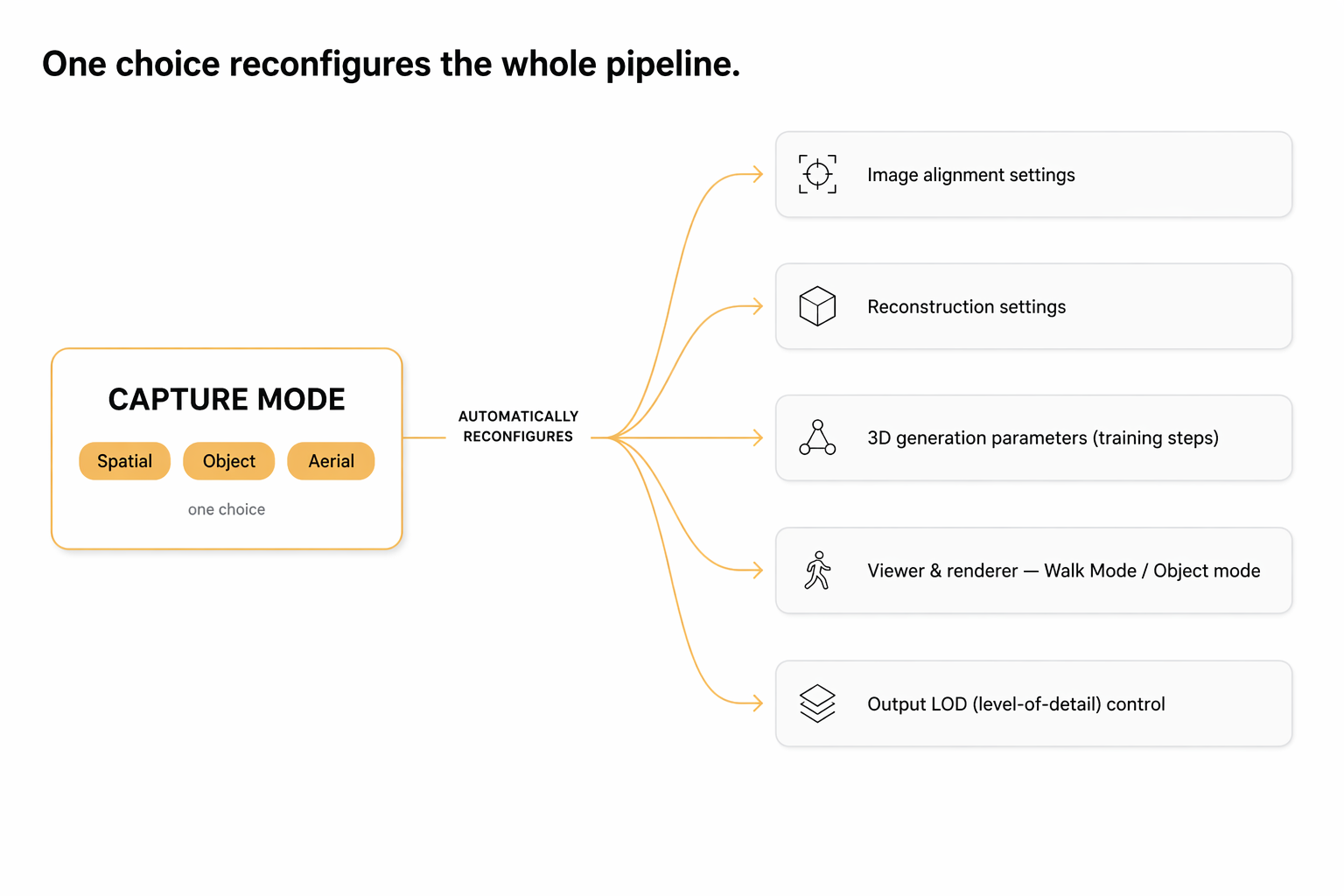
Tell it what you're capturing. It handles the rest.
Every other 3D tool makes you understand reconstruction before you can begin. I turned it into one choice: a room, an object, or a site. That single pick reconfigures the whole pipeline underneath, from how images are aligned to how you'll move through the result, so nobody touches a setting they don't understand.
You walk through it. You don't orbit it.
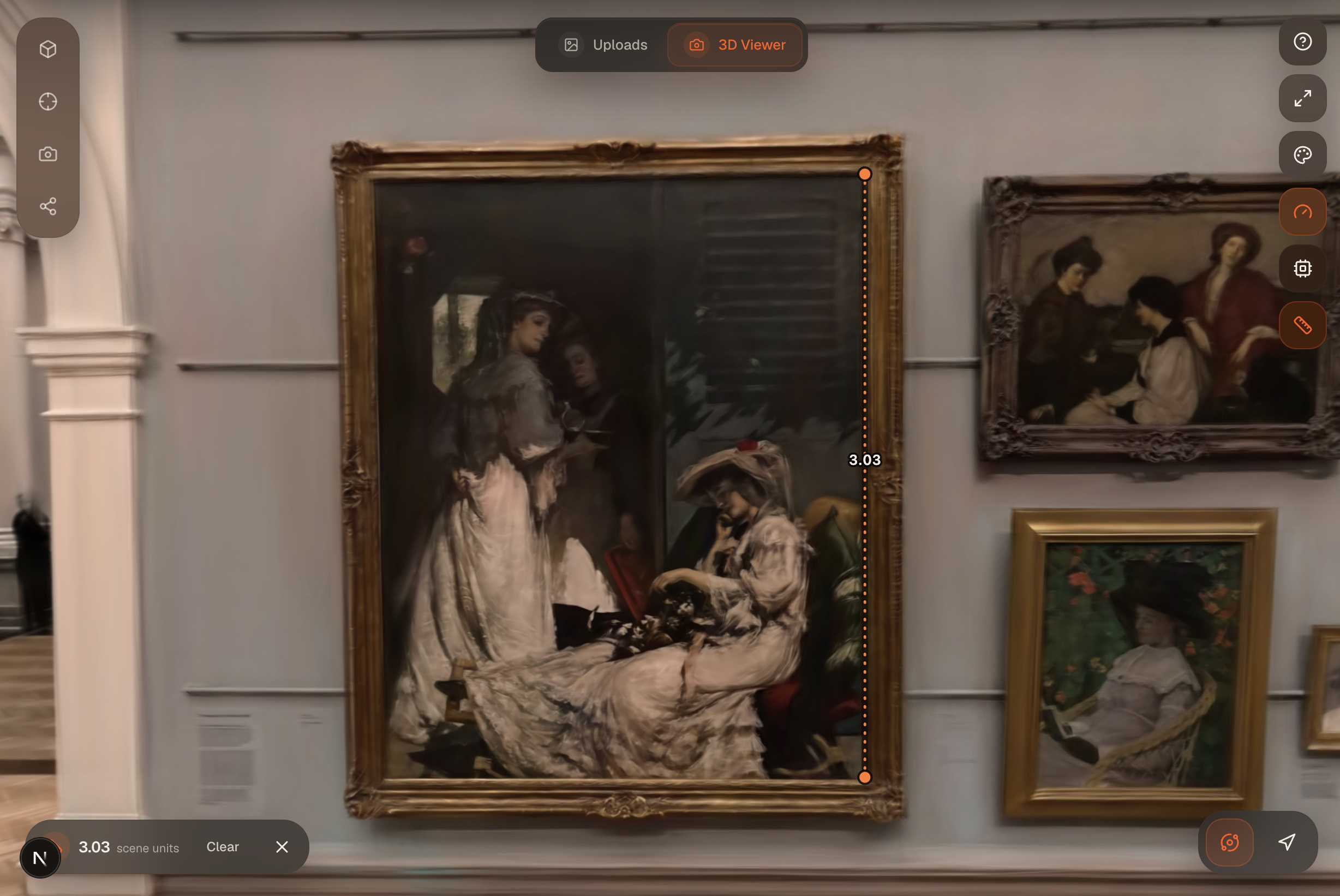
A normal viewer holds the place at arm's length while you spin it around, and that was the exact feeling I needed to kill. Here you drop in at eye level and walk, with an orbit mode a tap away for circling a single object. It runs the same on a phone as on a laptop, since that's where most shared links get opened.
Measure and mark up, right on the model.
Because the capture keeps true real-world scale, you can measure anything in the scene to the centimetre and pin notes wherever they matter. This is what lets one model do very different jobs: a story for a visitor, and a set of exact dimensions for a conservator tracking how a piece is holding up.
Fixing a raw capture without opening 3D software.
Captures come out with floaters, tilted ground and off colour. Cleaning that up normally means exporting to specialist software no heritage team has. So the editor lives in the browser: drag over the junk and delete it, level the model to the floor, tune the colour, save. That's the whole loop.
What we want a visit to feel like.
The old way hands you a file to spin. I'm designing for the opposite: you're inside the place, and it explains itself as you move. Four layers stack to get there.
Immersive visual
Walk in at eye level. Depth and light shift as you move, so it reads as a place, not a picture.
Audio & narration
Sound and voice fill the space and carry the story while you explore it.
AI cultural guide
Look at anything and ask. It knows the collection and explains what you're seeing.
Any language
Speak or type in your own language, and it answers back in it.
One immersive, game-like visit.
Easy to explore, easy to understand, and the same on an old phone as in a headset.
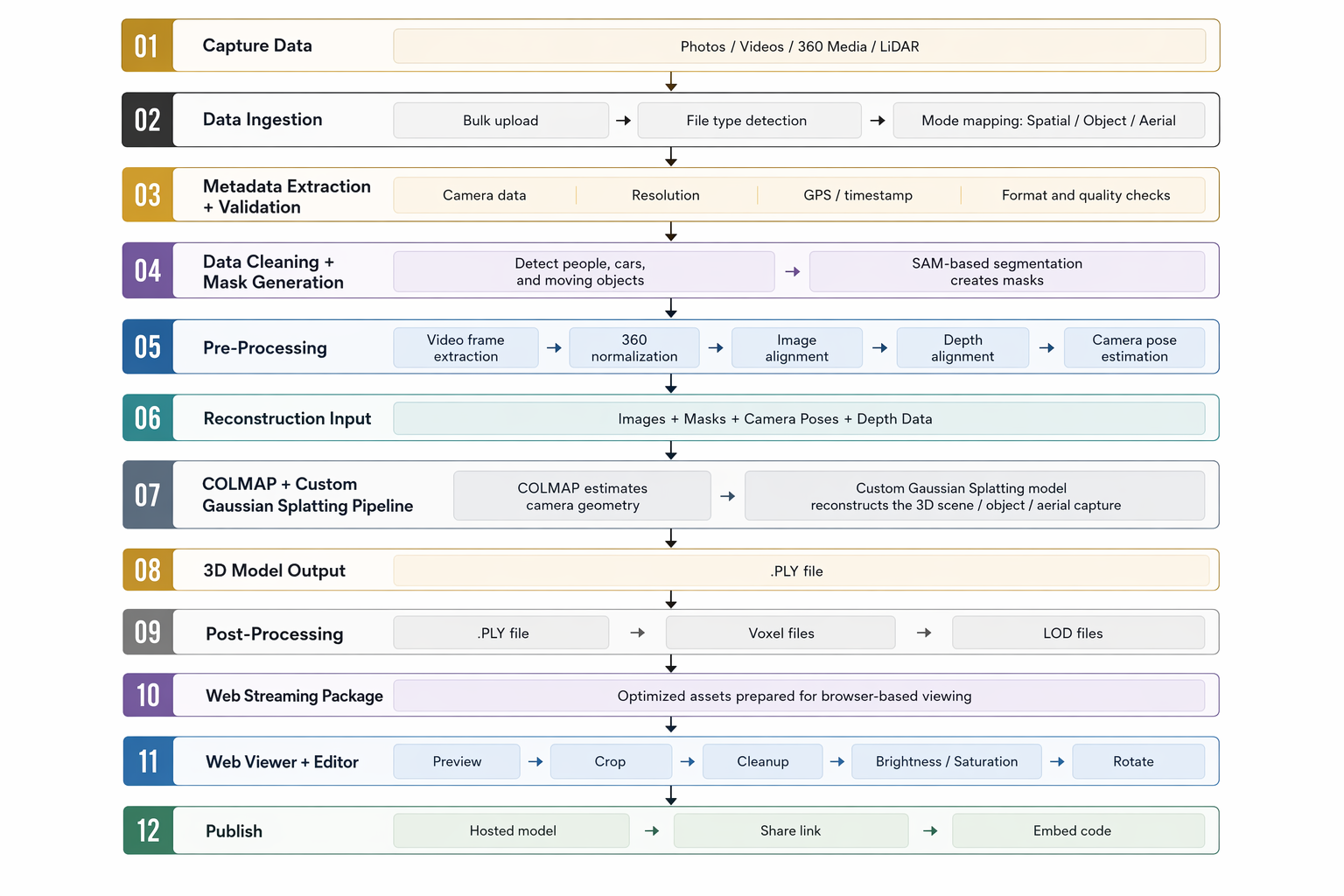
Under the hood, from raw capture to a web-ready model.
Everything a curator never has to think about: ingestion, cleaning, reconstruction and packaging, all handled so the choice they make is simply what to capture.
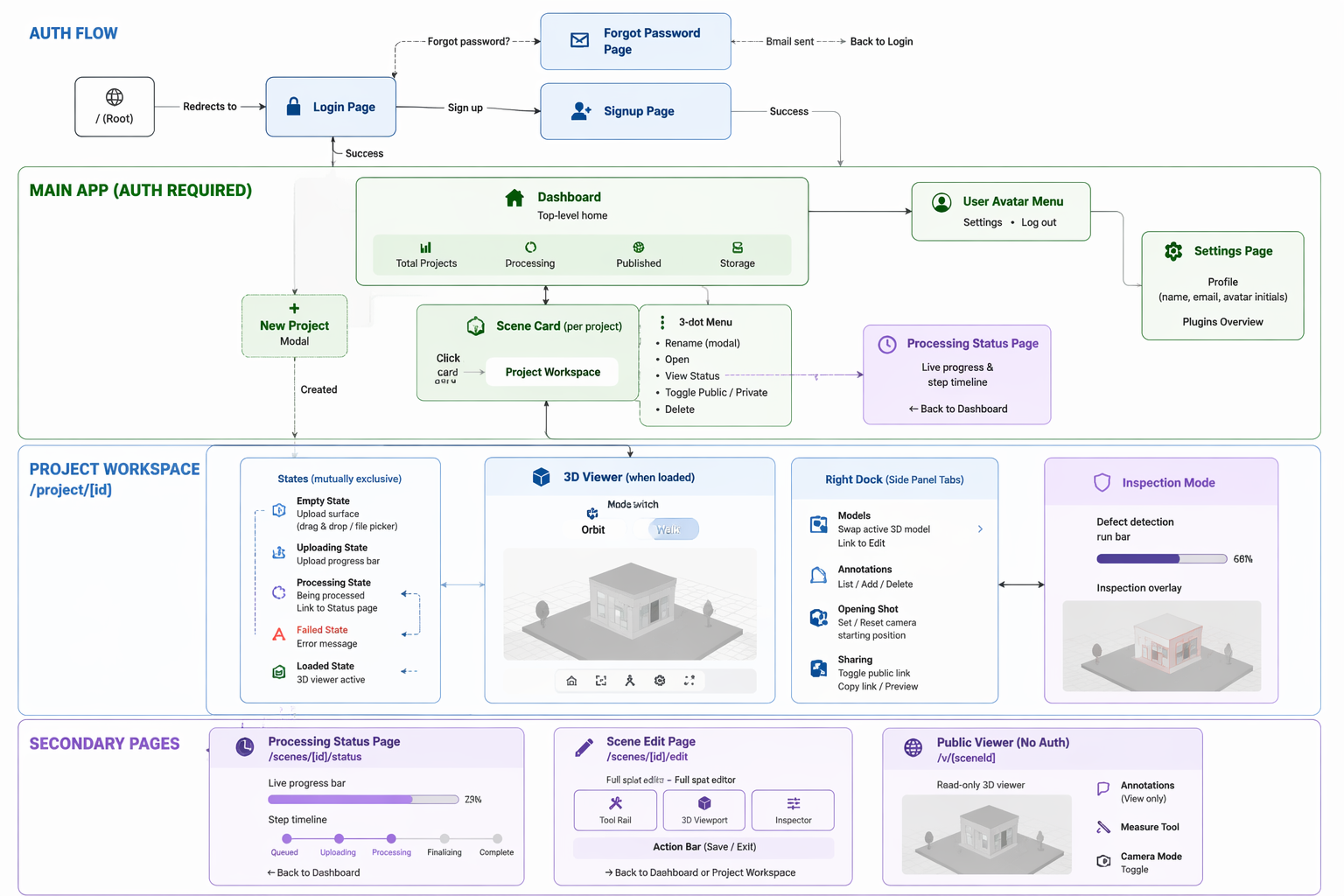
Initial ideation of the whole user experience flow.
Auth, the dashboard, the project workspace and all its states, the public viewer. I worked the entire journey and its edge cases out here first, so the real screens had somewhere solid to land.
Where it stands.
Splatr is a working MVP, backed by University of Leeds Spark and supported by early grants. As part of my ongoing dissertation and research, I'm now working with museums, galleries, libraries and historic sites across Leeds and London to build 3D digital twins of their spaces, so anyone can experience them virtually.
I kept the scope honest. This is one designer's product grown out of a research project, not a shipped platform with a million users behind it. But every screen here is real, and the part I care about most already works: not just saving a place, but making someone want to spend time in it.
Saving a place is one thing. Making people want to stay in it is the part I care about.